


As organisations continue to digitise services and operations, securing access to systems and sensitive information has become increasingly critical. For decades, passwords served as the primary line of defence for digital accounts. However, modern cybercriminals have become highly sophisticated at stealing, guessing, and exploiting passwords, proving that traditional credentials are an unreliable foundation for digital security.
To address this challenge, organisations are adopting robust authentication methods that look beyond a single credential. One of the most widely adopted and effective approaches is Multi-Factor Authentication (MFA).
By adding extra layers of verification to the login process, MFA makes it significantly harder for unauthorised actors to exploit compromised credentials. It acts as a core component of modern digital identity frameworks, balancing enterprise security with a friction-free user experience.
- What Is Multi-Factor Authentication (MFA)?
- The Three Core Authentication Factors
- 1. Something You Know (Knowledge Factor)
- 2. Something You Have (Possession Factor)
- 3. Something You Are (Inherence Factor)
- Why Passwords Alone Can No Longer Protect Businesses
- How MFA Elevates Digital Identity Security
- MFA Within Modern Digital Identity Systems
- Bridging MFA and Passwordless Authentication
- Strategic Benefits of MFA for Businesses
- The Future of Authentication
- Conclusion
- FAQs
What Is Multi-Factor Authentication (MFA)?
Multi-Factor Authentication (MFA) is a security mechanism that requires users to verify their identity using two or more independent security factors. Instead of relying solely on a single static password, MFA requires a combination of proofs to ensure that the individual requesting access is truly who they claim to be.
A typical modern MFA verification sequence might require a user to:
- Enter a traditional identifier, such as a username or password.
- Approve a secure notification sent to a trusted mobile device.
- Confirm their identity locally on that device using biometric verification (like a fingerprint or facial scan).
Access is granted only after all required factors are successfully validated. If an attacker manages to compromise one factor (such as guessing the password), the remaining layers prevent them from gaining entry.
The Three Core Authentication Factors
To understand how MFA works, it helps to break down the three distinct categories of verification factors used in identity security:
1. Something You Know (Knowledge Factor)
This refers to information that the user must remember. While historically the most common factor, it is also the most vulnerable to social engineering, phishing, and database leaks.
For example: Passwords, PIN codes, and answers to secret security questions.
2. Something You Have (Possession Factor)
This factor relies on the physical or digital possession of a verified, trusted object. Because an attacker would typically need physical access to the item, possession factors provide a major security leap over passwords alone.
For example: Smartphones running secure authenticator apps, hardware security keys, and cryptographic smart cards.
3. Something You Are (Inherence Factor)
This factor uses unique biological traits to verify identity. Biometrics provide a highly secure yet convenient entry point, as they cannot be easily forgotten, shared, or stolen.
For example: Fingerprint recognition, facial recognition, and iris scanning.
Why Passwords Alone Can No Longer Protect Businesses
While passwords remain a common sight across the web, relying on them as a single layer of security introduces severe corporate vulnerabilities:
- Widespread Password Reuse: Users frequently reuse identical or minor variations of the same password across multiple personal and professional accounts. A breach at a minor third-party service can expose corporate login details.
- Sophisticated Phishing: Modern phishing campaigns use highly convincing clones of corporate login portals to trick employees into willingly typing in their credentials.
- Data Breaches & Credential Stuffing: Automated scripts quickly test millions of leaked username and password combinations across corporate networks, easily compromising accounts that lack secondary protection.
- The Rise of Shadow IT: When employees adopt unauthorised software solutions without IT oversight, weak password management on those platforms creates unmonitored backdoors into the broader business ecosystem.
How MFA Elevates Digital Identity Security
According to major industry security standards, implementing MFA can block more than 99% of automated credential-based cyberattacks.
By shifting away from a single point of failure, MFA fundamentally changes an organisation’s security posture:
- Mitigating Account Takeovers: If an employee’s password is stolen in a third-party leak, the credential becomes practically useless to an attacker who cannot also replicate the biometric check or access the physical device.
- Mitigating Modern Attack Vectors: Advanced identity frameworks help counter emerging threats like MFA fatigue—where attackers spam users with push notifications hoping for an accidental approval—by introducing contextual matching or number-matching verification.
- Enhanced Identity Assurance: Combining multiple, independent data points gives IT administrators far greater confidence in user identity before granting access to critical infrastructure.
MFA Within Modern Digital Identity Systems
MFA achieves its highest security potential when it is fully integrated into an organisation’s overarching digital identity framework.
Legacy security models treated authentication as a static gate: once a password was typed correctly, the user had unrestricted access. Modern digital identity systems evaluate dynamic, real-time contextual signals alongside MFA.
Contextual Signals Evaluated:
- Verified Identities
- Trusted/Registered Devices
- Network Location & IP Integrity
- Historic Behaviour Patterns
This ensures that authentication isn’t just a one-time event at login, but part of a continuous trust assessment that protects sensitive services in industries like finance, healthcare, and government.
Bridging MFA and Passwordless Authentication
As authentication ecosystems evolve, organisations are increasingly exploring passwordless strategies. While passwordless and MFA are sometimes viewed as competing concepts, they are actually complementary.
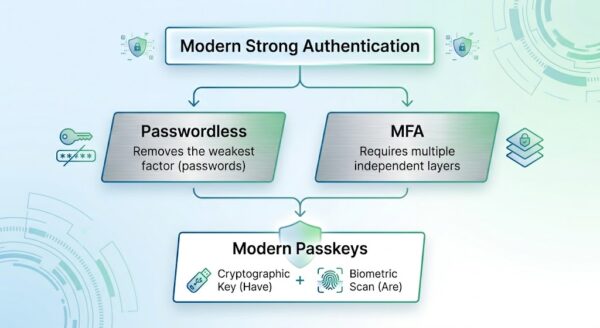
Modern passkeys inherently provide multi-factor security in a single, fluid step. When a user unlocks a passkey using a fingerprint or facial scan on their smartphone, they are simultaneously proving something they have (the device holding the private cryptographic key) and something they are (their biometrics).
By eliminating the password entirely, organisations remove the single largest vulnerability in the authentication chain while retaining robust multi-factor protection.
Strategic Benefits of MFA for Businesses
Deploying MFA across an enterprise delivers clear, measurable advantages:
- Regulatory & GRC Compliance: Implementing strong multi-factor authentication is an explicit requirement across many global compliance frameworks, data protection laws (such as GDPR), and cyber insurance policies.
- Securing a Remote Workforce: With employees connecting from various external networks, MFA ensures corporate data remains isolated from unauthorized access outside the traditional office perimeter.
- Building Stakeholder Trust: Clients, partners, and users are significantly more confident interacting with digital platforms that visibly prioritize modern account security.
Need to know more? We’re here for you.
The Future of Authentication
The evolution of digital security is moving rapidly away from shared secrets and static credentials. The future belongs to an integrated model combining:
- Cryptographic passkeys and passwordless protocols.
- Localised biometric verification.
- Context-aware, continuous identity security models.
MFA will remain a cornerstone of this evolution. However, the focus will continue to shift away from tedious manual prompts and toward seamless, automated layers of trust that protect infrastructure without hindering productivity.
Conclusion
Relying on passwords alone is no longer a viable strategy in a sophisticated threat landscape. Multi-Factor Authentication (MFA) bridges the security gap by requiring independent layers of verification before granting access to digital assets.
Whether configured alongside traditional infrastructures or built directly into modern, passwordless passkey architectures, MFA is a critical asset for establishing true digital trust, achieving regulatory compliance, and securing the modern enterprise.