

Digital identity has become a fundamental pillar of how individuals access services, prove their identity, and transact online. From banking and healthcare to public administration and enterprise workplace networks, organizations increasingly rely on digital identity frameworks to cultivate trust in virtual environments.
But before a user can utilize a digital identity to access restricted corporate or consumer systems, a foundational security question must be answered:
How can an organization be absolutely certain that a remote individual is truly who they claim to be?
This is the precise domain of identity verification.
Identity verification is the rigorous process of establishing and validating a person’s real-world identity before issuing credentials, granting system access, or enabling digital transactions. It forms the absolute baseline of trust in any digital identity ecosystem. Without robust identity verification, subsequent security controls lack a reliable foundation.
- What Is Identity Verification?
- Identity Verification vs. Authentication
- Common Methods of Remote Identity Verification
- Government-Issued Identity Documents
- Biometric Matching and Liveness Detection
- Cross-Referencing Official Registries
- The Role of Verification in Security and Compliance
- The Future: eIDAS 2.0 and Reusable Identity Wallets
- Conclusion
- FAQs
What Is Identity Verification?
Identity verification—often referred to in technical frameworks as identity proofing—is the mechanism used to confirm an individual’s legal identity using trusted, independent evidence.
The core objective is to ensure that an applicant registering for a service or attempting to obtain a digital ID is genuinely the person named on the credentials. This process serves as a gateway and typically occurs during high-stakes digital events:
- Opening financial accounts or managing investment portfolios.
- Registering for municipal, national, or healthcare public e-services.
- Provisioning an employee’s enterprise corporate identity (workforce onboarding).
- Accessing highly regulated digital services or signing legally binding contracts.
By establishing absolute trust at the very beginning of the relationship, organizations can make informed, context-aware decisions about access and risk throughout the user’s entire identity lifecycle.
Identity Verification vs. Authentication
While identity verification and authentication are closely linked components of identity and access management (IAM), they occur at different stages and solve entirely different security challenges.
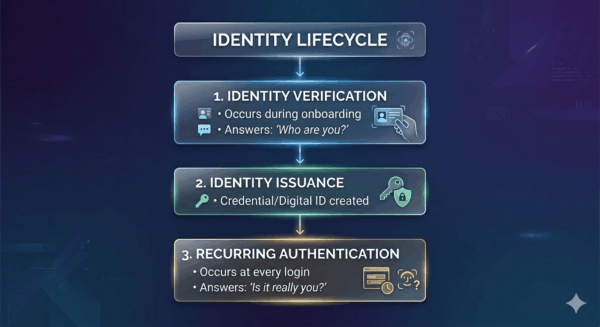
- Identity Verification establishes who a person is. It occurs once (or periodically when re-verification is triggered) during onboarding to create a trusted digital identity profile.
- Authentication verifies that the person trying to log in at any given moment is the legitimate owner of that pre-verified identity. It occurs continuously, every time access to a system is requested.
Common Methods of Remote Identity Verification
To achieve a high degree of confidence without face-to-face contact, modern digital identity infrastructure relies on a combination of highly secure automated and cryptographic methods:
Government-Issued Identity Documents
Passports, national ID cards, and driving licenses remain the primary root of trust. Modern digital verification doesn’t just look at a photo of a document; it analyzes security features (watermarks, holograms, MRZ text zones) and uses NFC (Near Field Communication) technology to cryptographically read and validate the secure data stored inside biometric passport chips.
Biometric Matching and Liveness Detection
To prevent attackers from using stolen physical documents, biometric verification takes a high-resolution facial scan of the user and matches it against the verified photo from the identity document. Advanced systems employ AI-driven liveness detection to ensure the applicant is physically present, blocking spoofing attempts that use photos, video replays, or deepfakes.
Cross-Referencing Official Registries
To elevate confidence to the highest standards, verification platforms can securely query authoritative national government and population registries in real time. This confirms that the document presented is active, valid, and matches current state records.
The Role of Verification in Security and Compliance
Identity verification is not merely an isolated security control; it is the cornerstone of corporate governance, risk management, and legal compliance (GRC).
KYC and AML Compliance
In the financial, fintech, and insurance sectors, Know Your Customer (KYC) and Anti-Money Laundering (AML) regulations legally obligate businesses to verify the identity of their clients. Failing to implement robust, auditable identity verification can lead to severe regulatory penalties and reputational damage.
GDPR and Data Governance
Under the General Data Protection Regulation (GDPR), organizations must enforce data minimization and ensure that sensitive personal or corporate data is only accessible by authorized individuals. Verifying an identity prior to granting data access prevents data breaches caused by identity spoofing or social engineering.
Levels of Assurance (LoA)
Identity frameworks define trust using Levels of Assurance (typically LoA1 to LoA3 under regulations like eIDAS). High-risk transactions require LoA3 (Substantial/High), which can only be achieved through cryptographic document verification, biometric checks, and verified registry lookup, ensuring absolute non-repudiation.
Let us guide you through identity technology.
The Future: eIDAS 2.0 and Reusable Identity Wallets
The landscape of identity verification is shifting rapidly away from repetitive, manual document scanning toward seamless, reusable digital identities.
Driven by frameworks like Europe’s upcoming eIDAS 2.0 regulation, the future belongs to European Digital Identity Wallets. Under this model, an individual verifies their identity once with an authoritative issuer (such as a bank or a qualified eID provider).
The verified attributes are then stored securely in a mobile wallet. When interacting with businesses or public infrastructure in the future, the user can instantly verify their identity without scanning documents again—sharing only the specific, cryptographically signed attributes requested.
Conclusion
Relying on unverified user assertions is no longer viable in a perimeterless digital ecosystem. Identity verification acts as the initial filter that keeps malicious actors outside the corporate or consumer ecosystem.
By employing rigorous, compliant, and user-centric verification frameworks, organisations do more than mitigate fraud and achieve regulatory compliance—they establish the foundational digital trust required to build seamless, long-term digital relationships.
FAQs
What is identity verification?
Why can’t we just rely on authentication like MFA?
How does identity verification support GDPR compliance?
What is a “reusable” digital identity?
About the Author: Aleksandar Laban